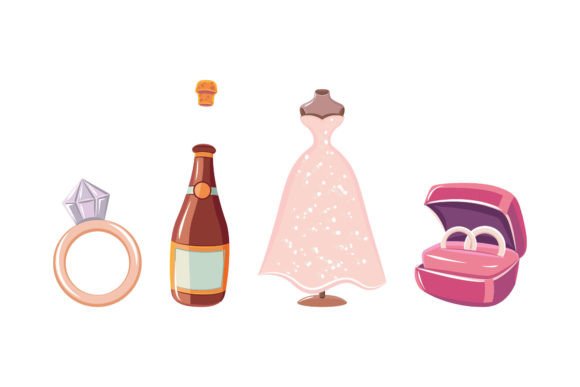
Wedding Gifts Vector Art: Essential Design Assets
When you are building a visual identity for a wedding-related business or creating invitations for a friend’s big day, the imagery you choose speaks volumes. Wedding Gifts Vector Art isn't just a collection of line drawings; it represents a specific aesthetic that blends romanticism with technical precision. As designers, we often struggle to find stock imagery that feels authentic rather than generic. This specific niche of vector art focuses on the tangible elements of a wedding celebration—from wrapped boxes and tote bags to wine glasses and bouquets—but rendered in a clean, scalable format that is perfect for modern typography and digital layouts.
Visually, high-quality wedding vector art tends to favor a minimalist yet elegant style. You will often see single-weight line work, sometimes combined with solid color blocks, to create icons that are instantly recognizable. The "personality" of these assets is usually sophisticated, celebratory, and clean. Unlike raster images that pixelate when scaled, these design assets allow you to blow up a gift box icon to billboard size for a venue backdrop or shrink it down for a favicon on a wedding planning website without losing an ounce of clarity. For the entrepreneur or small business owner, this versatility is not just a convenience; it is a necessity for maintaining a professional brand identity across multiple platforms.
Strategic Applications for Branding and Marketing
Understanding where Wedding Gifts Vector Art fits into the broader design ecosystem can save you hours of production time. For logo design, these vectors serve as excellent starting points or complementary marks. Imagine a bespoke gift wrapping service; using a vector illustration of a ribbon or a box allows you to create a logo that is distinct and scalable. In packaging design, these elements are invaluable. You can use a repeating pattern of small wedding icons to create custom tissue paper, box liners, or sticker seals that elevate the unboxing experience for the customer.
For those in editorial design and publishing, the utility extends to layout and decoration. If you are a blogger writing about registry ideas or a publisher producing a bridal magazine, vector art provides perfect spot illustrations. They break up large blocks of text, add visual interest, and guide the reader's eye down the page. Because they are vectors, you can easily change the color palette within software like Adobe Illustrator to match the specific color scheme of the current issue or blog post theme. This ensures consistency while allowing for creative flexibility.
Digital applications are equally robust. Social media graphics for wedding planners and venues require fresh content constantly. Having a library of wedding vector art allows you to quickly create Instagram stories, Pinterest pins, or Facebook event covers. When paired with the right display font or script font, these graphics can drive significant audience engagement. The clean lines of the vector art often provide a necessary visual resting place when used alongside ornate typography, helping to balance the overall composition.
Pairing Visuals with Typography
A vector illustration rarely lives in a vacuum; it almost always works alongside text. This is where the relationship between imagery and typeface becomes critical. Wedding Gifts Vector Art typically has a modern, clean aesthetic, which makes it surprisingly versatile for font pairing. If you are using a script font for the main headline (like "Save the Date"), the clean geometry of a vector gift icon can anchor the design and prevent it from looking too messy.
Conversely, if your primary text is a sturdy sans serif font or a serif font, adding a delicate line-art vector can soften the look and inject some romance into the layout. The key is to match the "weight" of the art with the weight of the font. Heavy, bold vector illustrations pair well with bold typefaces, while thin, delicate line art suits lighter, more airy fonts. This attention to detail contributes to visual hierarchy, ensuring that the viewer knows exactly where to look first. It enhances readability by framing the text rather than competing with it.
Practical Guide to Selection and Licensing
When sourcing these assets, it is tempting to grab the first free set you find. However, for serious commercial work, investing in premium font and vector bundles is usually the smarter route. High-quality commercial font and vector licenses often come with better support and more detailed file formats (like AI, EPS, and SVG). Before downloading, always review the included styles. Does the pack offer just outlines, or does it include filled versions? Are there different file formats compatible with your software?
Evaluating project fit is a practical step many skip. Look at the visual style of the vectors. Do they look overly "clip-art-ish," or do they possess a hand-drawn, organic quality? If you are designing for a high-end luxury brand, you need vectors that look bespoke, not generic. For crafters and hobbyists using cutting machines like Cricut or Silhouette, you must ensure the vectors have clean paths without stray nodes, which can ruin a cut.
Licensing is the final, non-negotiable checkpoint. If you are a marketer or entrepreneur creating merchandise to sell—such as mugs, t-shirts, or printed stationaries—you need a license that explicitly permits commercial use. "Personal use" licenses do not cover items intended for profit. Check if the license is per-project or if it covers multiple products. This due diligence protects your business from legal headaches down the line.
Maximizing Your Design Assets
To truly leverage Wedding Gifts Vector Art, think beyond the obvious. Use these vectors as watermarks on photography proofs. Use them to create custom patterns for website backgrounds. Use them as part of a larger brand identity system where the icons become a recognizable language for your brand. By integrating these creative font companions and vector illustrations thoughtfully, you create a cohesive visual world that feels professional and inviting. Whether you are a designer building a client's suite or a bride-to-be making DIY favors, these assets bridge the gap between a concept and a polished reality.